Works best on a computer or tablet. Free, no sign-in.
What it does
Turn the map
See all 73 stars at their printed heights, above and below the plane, from any angle.
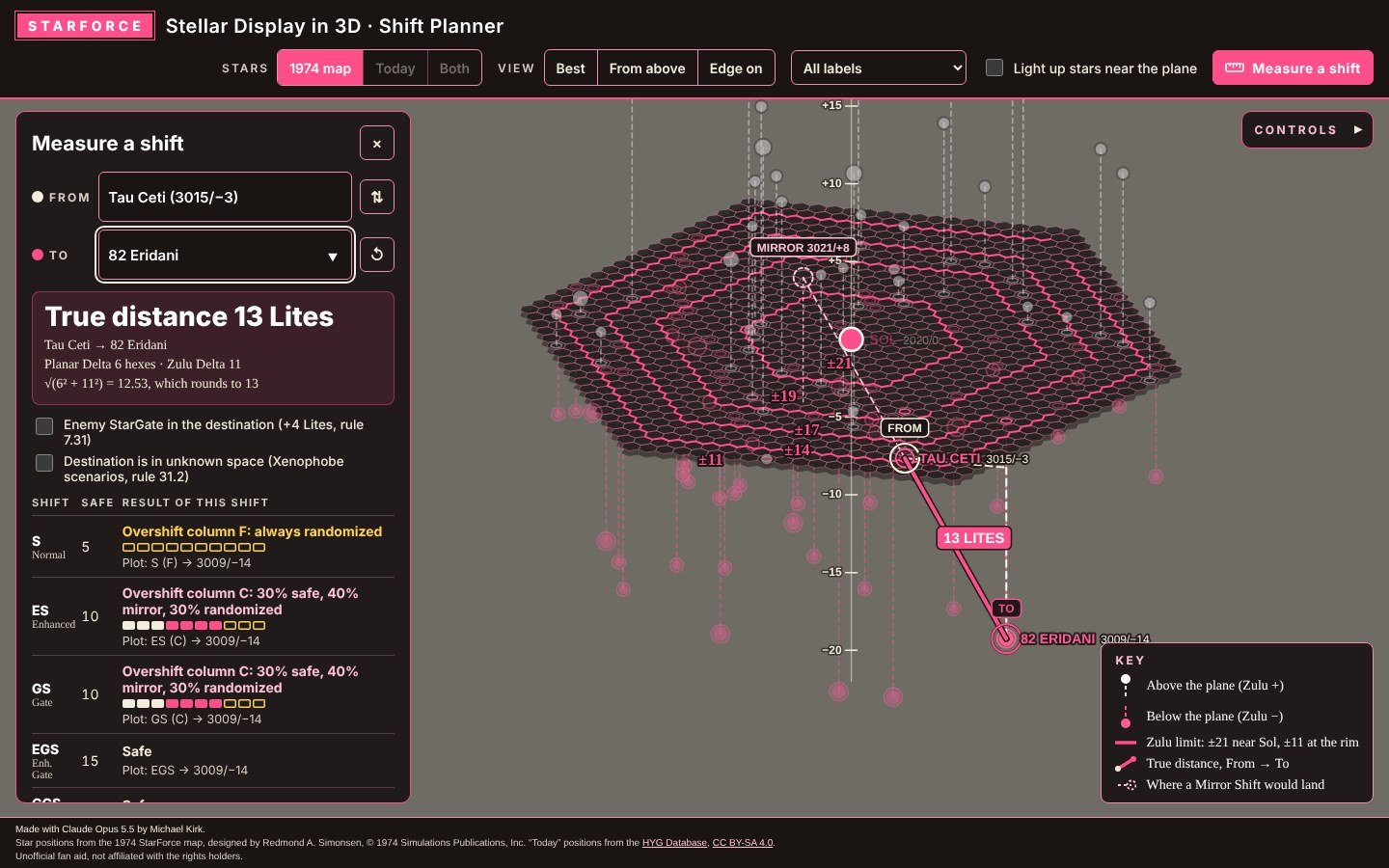
Measure a shift
True distance between any two points, the Overshift odds for S, ES, GS, EGS and GGS, and where a Mirror Shift lands.
1974 and today
Compare Simonsen's star positions with modern measurements and see which stars have moved.
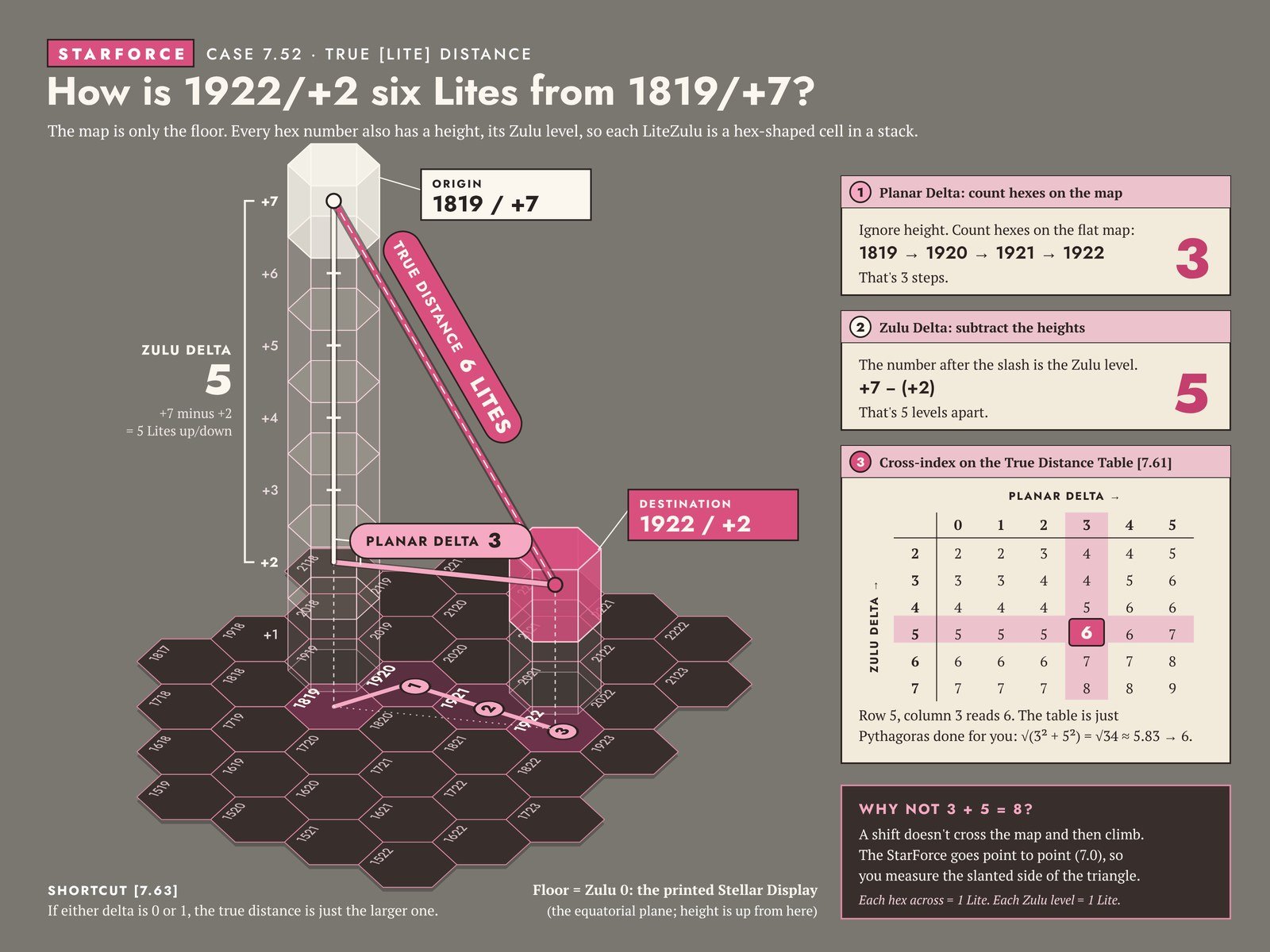
How true distance works
Count hexes across the map, subtract the Zulus, and take the slanted side of the triangle. Case 7.52 from the rules, worked out in three dimensions.
The whole Stellar Display
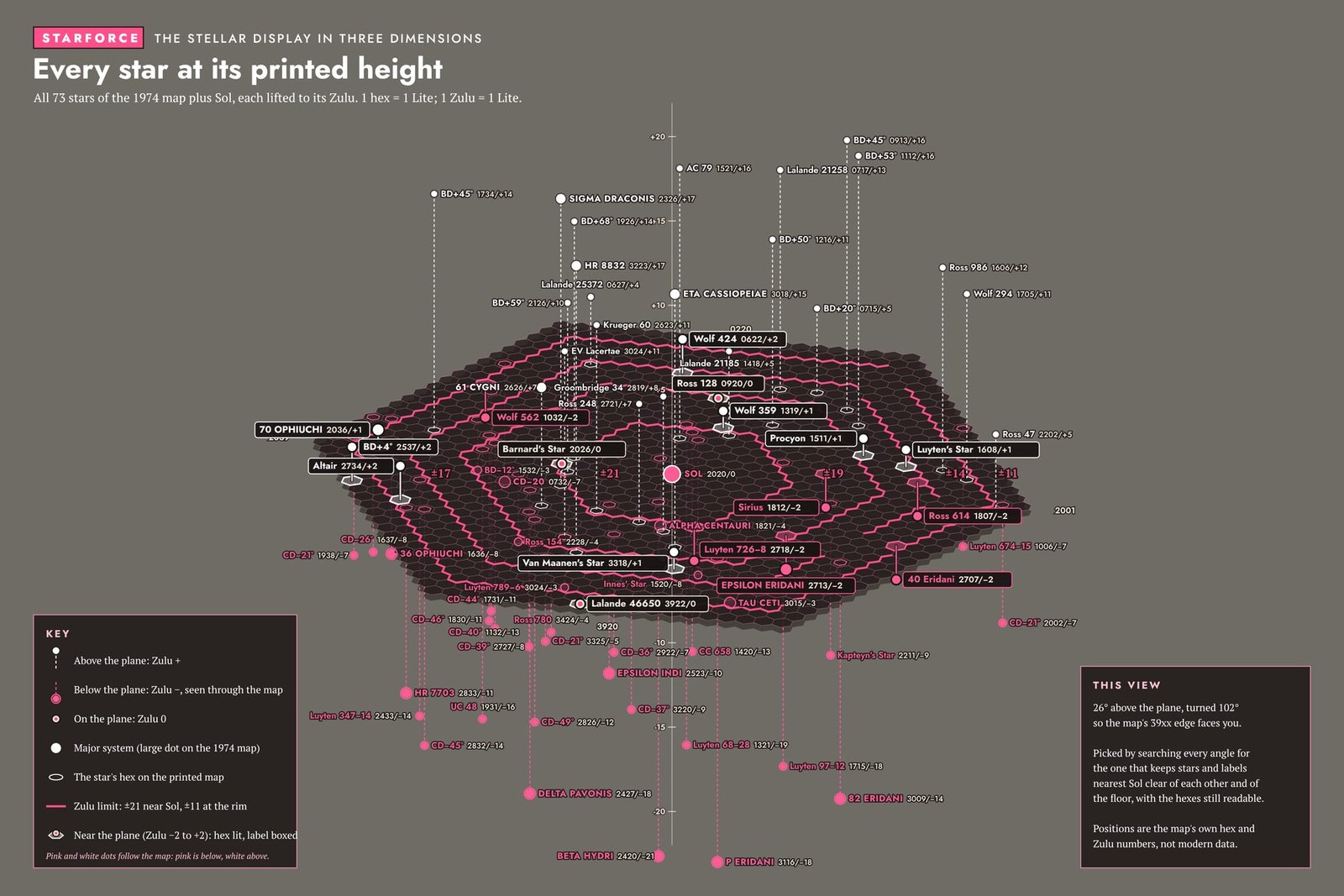
All 73 stars plus Sol at their printed hex and Zulu. White stars sit above the plane, pink stars below it, as on the original map.
Redmond A. Simonsen, SPI’s longtime art director, designed StarForce in 1974. It was the first game he designed entirely on his own. Its Stellar Display looks like a flat hex map, but every star carries a hidden third coordinate: the number after the slash is its height above or below the plane of Earth’s equator. John Boardman and George Heap compiled the star positions; Simonsen turned them into a playing surface. Measured against a modern star catalog, the map holds up remarkably well. Of the 68 stars that can be matched today, 40 sit at exactly the Zulu that current data gives them, and 24 more are off by a single Lite. The few that miss by more are stars astronomers have since measured farther away. Even the pink Zulu limits are exact: they step down with hex distance from Sol, so the playable volume is a sphere with a radius of about 22 Lites, drawn as rings on a flat sheet.
The rules are just as precise. Building the Shift Planner meant turning every table in the game into code: the True Distance Table, the Maximum Shift Table, the Overshift results, the Mirror Shift and the rule that keeps a mirrored StarForce on the map. Not one of them required guesswork. Every worked example in the rulebook comes out exactly as printed, from a six-Lite shift out of 1819/+7 to a twenty-five-Lite Gate-to-Gate jump out of 1319/+1. In “The StarForce Tapes,” talking with John Boardman and Neil Shapiro, Simonsen said a holographic projection was what he had in mind when he visualized the map. This page simply draws what he imagined. Good game design and good software demand the same discipline, rules exact enough that a machine cannot argue with them, and StarForce had it from the start.